First Amendment
“Congress shall make no law respecting an establishment of religion, or prohibiting the free exercise thereof; or abridging the freedom of speech, or of the press; or the right of the people peaceably to assemble, and to petition the Government for a redress of grievances.”
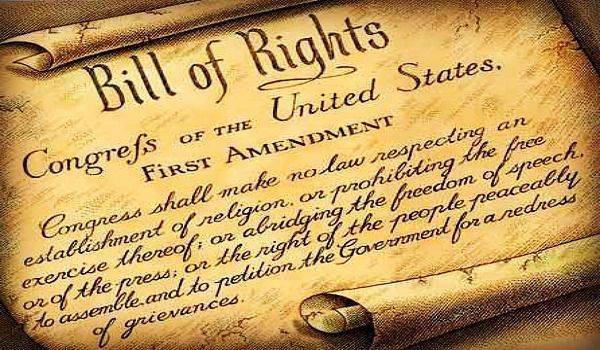
Credit s3.amazonaws.comThe First Amendment of the constitution summarizes the freedom of rights every citizen of the USA inherits. The freedom to exercise these rights on elaboration, sets limitations to this exercise, according the profession based on moral and ethical fundamentals. Ethical guidelines are to encourage fair use of these constitutional rights. So fundamental, yet strong rights are very susceptible to misuse and manipulation by unfair means, hence following ethical guidelines become a necessity to keep all the freedom of rights under check. Ethics can reach beyond law’s approach. A photographer can click a photo well within the rules of law, which cannot be challenged legally but, what if that photo is biased and carries an agenda. All freedom of rights, especially freedom of speech and press is like a magnificent ship sailing in an ocean but without a compass. Ethics can act as a navigation system not only in such situations but always. First Amendment which safeguards the freedom of rights can be misused to breach privacy along with unethical use of unfair methods to convey a biased message.
In context to Photojournalism, based upon ethical grounds, certain limitations are prescribed in exercising the First Amendment. A visual story-teller shoulders greater ethical responsibility towards the society. To provide accurate, unbiased and factual information and fearlessly perform their duties. Being a Photojournalist is far different in numerous ways to a photographer. To point out few out of many noticeable and important differences: A photographer may or may not voluntarily follow ethical guidelines, while for a Photojournalist it is an essentiality of profession. A Photojournalist’s objective to click a photo is much different then that of a photographer. A photographer’s work can be a marvelous picture, whereas a photojournalist’s work can tell a deep and significant story. A photographer may have a bias or their own perspective in pictures they shoot, whereas a photojournalist displays unbiased facts and portrays truth. According to Kenneth Kobre “ a general rule of thumb might be that photographers are within ethical bounds as long as the photograph they shoot illustrates the news accurately, even if the picture does not record the event as an exact facsimile”( Kobre Kenneth, Photojournalism: The Professionals Approach, 1980, p.327)
Kobre unveils the dissimilarities between limits of a profession and its extent to operate freely, and individual boundaries of exercising First Amendment rights and protection of privacy. He mentions that “According to legal scholars, the First Amendment right to gather and disseminate newsworthy information far outweighs the nebulous ‘right of privacy’.” ( Kobre Kenneth, Photojournalism: The Professionals Approach, 1980, p.308). Federal and state laws have been designed to protect individual rights and strengthening those rights under the constitution. These laws force the professionals to respect an individual’s right and restricts the photojournalist’s freedom of speech and press. Most commonly recognized basics to ensure individual privacy as well as to provide ethical guidelines for a profession’s freedom to dispose through their duties.
Which restricts:
- A photojournalist from entering into any private property uninvited
- To use pictures without consent of the individual to sell products
- Using the pictures as a means of harassment
- Manipulating their photography skills to portray someone in bad shade
- A photojournalist from shooting truthful photos, private or otherwise which display an individual’s embarrassment
Locations and situations where and when photojournalists are allowed to take pictures can be categorized on the limitations and access of freedom of press. Category one, Public areas such as: sidewalks, parks, zoo schools, colleges, universities and other such areas are freely accessible and do not require any permissions; including shooting from a public area into private area. Category two, places like; theatre, business or hotel lobbies or restaurants. Photojournalists can shoot in semi-public places, which are owned by private parties but open to public. Unless and until no one is objecting the shoot. Un-objected access is also required to take pictures of private properties like home, apartment, car and porch or lawn. Category three, public places with restrictions like government buildings or police headquarters or museums where camera may not be allowed beyond certain limits or few specific areas may not be accessible to shoot pictures. Last and final category four are public and private places where prior permission is required before shooting pictures. Medical sector leads this category, all forms of healthcare services will need permission before taking photos. For shooting in government establishments like courtroom, prison and legislative chambers is also required.
Manipulating photos is an absolute no in the profession of photojournalism. Photojournalists are allowed to process and resize images to create a better impact. But, be careful, those actions do not in any possible way effect the truthfulness of the story, then only the photos should be processed. When a photojournalist manipulates photos with malicious intent, to convey false or biased message, adds or deletes objects in pictures lose their credibility. One photojournalist’s wrong move raises questions on other professionals in similar field as well. something like ‘Payola Scandal’.(history.com)
Credibility is the most prestigious recognition and reward for every photojournalist that can be achieved by following ethics and laws of photojournalism, by being truthful, unbiased and factual. To rise beyond personal expectations and serve with selfless devotion to the profession of photojournalism.
Shehbaz Khan
#First Amendment, #pressfreedom, #journalismethics, #crediblemedia #photojournalist #truephotojourno
References:
Kobre Kenneth, Kobre Kenneth, ‘Photojournalism: The Professionals Approach’, Curtin & London Inc, 1980.,
https://s3.amazonaws.com/files.fa-mag.com/live/uploads/2018/03/bill-of-rights-first-amendment-free1.jpg (First Amendment image credit)
https://www.history.com/this-day-in-history/the-payola-scandal-heats-up
 SK Photojournalism
